Gambling on taste: the expected value of knowing your type
Is love really the kind of thing you “gamble” on? Well, romance and roulette might not seem like they’re in the same category. But both a common-sense examination and romantic dramas answer the question in the affirmative. In this post I’ll explain why - and how.

Love Is A Gamble
Let’s start with the common-sense examination. When you first pursue someone, do you know for sure if she’ll return your interest? No. Or at least very rarely. Few of us chase guaranteed wins, because the payout is too low to justify playing: they’re guaranteed only because she’s far below our value. We also don’t pursue guaranteed losses. Chasing someone far above our value would be a waste of energy - and embarrassing besides. Since we pursue women who are neither guaranteed wins nor guaranteed losses, we are… gambling. Yep. That’s the word.
Romantic dramas often show the hero and heroine meeting through some rare chance. For instance, many thousands of people get on and off the subway every day with no problems, but our couple happen to run into each other at full speed, whereupon they fall flat on the ground in each other’s arms. Luck of this sort is admittedly a bit different from gambling, because it doesn’t entail a choice to play. But in real life, you basically never win anything without trying to play. And if you were to intentionally wander the subways, or repeatedly get on and off city buses, hoping for the kind of romantic crash-landing you see in movies, then you would be, again, gambling.
It goes without saying that not every gamble is a good one. A casino is a place where people with bad instincts go to lose everything they own; and riding on city buses for a hobby is sad. There’s a science to gambling well. Casino owners know it - and their customers mostly don’t.
So whether we start from romantic dramas or use common sense, we can derive a simple syllogism. Love is a gamble. There’s a science of gambling. Therefore: there’s a science of gambling on love.
The Science Of Gambling On Love
We don’t need particularly sophisticated math to lay the foundations for our new science of love gambling. If my memory is correct, the next few equations were covered in ninth grade (after which I got better and better at avoiding math class - so nobody can say I wasn’t learning anything). To calculate the expected value of a gamble, you simply multiply the chance of success by the possible winnings and the chance of failure by the possible losses, and sum them. Thus, a coin toss where you win the same on heads that you lose on tails is a gamble with an expected value of zero.
Let’s get our hands dirty right away and apply this to love. Mary is standing over there in the corner making eyes at you. Or, is she just squinting at you balefully? Well, you’re not quite sure, but maybe you should take your chances anyway.
Let’s lay the gamble out so we can calculate. If Mary says “yes,” you win… Mary. But if she says no, we’ll dump you in ice water long enough that you’ll wish you’d never heard her name. For this first, hypothetical example we’re just going to pretend those potential winnings and losses cancel out. And if your chance at winning Mary is 50% and winnings and losses cancel out, the expected value of pursuing her is… zero. Just like in our coin toss example. Thus, it doesn’t matter if you pursue Mary, or read someone’s beauty blog on your phone.
Normally a rejection doesn’t lead to an extended ice bath (though sometimes it might feel like it); and normally your odds are going to be lower than 50% (there are many reasons someone might not be into you). Assigning an accurate numerical value to your gains and losses and determining your chances isn’t easy, and I chose simple numbers here to make our first example straightforward. But now that we’re clear on the basic principle, let’s try to do better.
Winnings, Losses, And Chances
To advance the science of love gambling we need to reflect on what the winnings, losses, and chances are in our real-life love gambles.
The winnings are the easiest: everyone agrees having the best lover is one of the best things in life. To save time I’m not going to bother listing out all the benefits.
The losses are much less obvious: at first blush, the downsides to chatting someone up seem trivial. Nevertheless, with a little thought we can list three. First, potential damage to your social status. If your approach is weak or your target turns out to have been poorly chosen, you’ll suffer a reputational cost (“he’s awkward”); and if other people see or hear that you’ve been rejected, you’ll also suffer a reputational cost. Second, opportunity cost. Time spent pursuing one woman is time not spent pursuing another - or just doing other things entirely. In a sense, you have to pay to play. That holds even in the online dating market, because you can only swipe so many times per day. Furthermore, if you do succeed in catching Mary but she turns out to be an unimpressive lover, you’ll have wasted time on her that could have been better spent with some better candidate. And third, most of us have a psychological aversion to romantic rejection that’s much higher than I can find any way to justify objectively. Maybe this is just bias, or maybe it’s motivated by some important factors I can’t discern, but it remains the case regardless.
As for our chances, we consider various inputs to weigh them. These include our past successes and failures, our estimate of our own attractiveness ranking, our estimate of our target’s attractiveness ranking, our estimate of how well we’ll mesh with her particular character, signals of how easy or hard she is, the context and the nature of our existing social relationship, and so forth. It’s hard to make an exhaustive list, but those are the principal factors.
So: we’ve successfully identified the main winnings, losses, and inputs to our mental probability model. Are we now ready to calculate real expected values and determine which bets we should take? Unfortunately not.
While describing how we model our chances, I had to keep writing “estimate.” Some of our estimates are very rough, and perhaps no better than random guesses. Basically, we don’t know if our probability model is correct. And how can we make good decisions if our probability model is wrong?
Seems like the science of love gambling needs a little work.
Uncertainty About Uncertainty
In a coin toss or a card game, all risks are known. Indeed, we can specify them with mathematical perfection. But in most real-world decision making - whether in investing, in our career and life decisions, or in romance - important inputs to the risk are not known to us, and we estimate them on the basis of unreliable signs. That means we can’t calculate exact probabilities. Instead, we have uncertainty about the uncertainty.
Consider the following game. There are two bags, each of which contains one black ball and an unknown number of red balls somewhere between six and sixteen. If you pull the black ball, you win; if you pull a red ball, you lose. Now, suppose the winnings and losses are such that you calculate a positive expected value if the bag contains fewer than eight balls. From your perspective, the number of balls in each bag might as well be random too, with an even probability distribution over the given range. By consequence, you calculate a negative expected value for any bet: chances are the bags just contain too many balls. Naturally, you don’t gamble.
Now let’s use the exact same bags but vary the available information. This time I’ll tell you the number of balls in each. Bag one contains seven balls. Bag two contains sixteen balls. That means the expected value of a bet on bag one is positive, while the expected value of a bet on bag two is negative. Armed with this information, you bet on bag one - and win.
What the example games show is that when we have uncertainty about uncertainty, gambling on the basis of the upper-level expected value doesn’t maximize the winnings that are theoretically possible at the ground level of irreducible randomness. By decreasing our uncertainty about the uncertainty, we can increase our winnings.
Let’s apply this abstract observation to our nascent science of love gambling.
When we choose whether to pursue someone, we’re not just uncertain about the outcome. We’re also uncertain about our modeling of the outcome. So each time we’re not only gambling on the gamble, as it were, but also gambling on our model of the gamble. By consequence, we’re almost inevitably leaving winnings on the table - just as we did when we declined to bet on the two bags before we knew how many balls each contained.
The important upshot for our purposes here is that if we can reduce our uncertainty about uncertainty in love gambling, we can increase our romantic winnings by correctly identifying which love gambles have the highest ground-level expected value.
Enter Relationship Alpha
In a previous blog entry I defined the concept of “relationship alpha.” In the interest of advancing science, I’ll go over it again briefly and then explain its relevance here.
Each of us has a type we like more than the crowd does. The more popular a possible romantic target, the lower our chance of success with her, because we have more competition. Conversely, our chance of success is higher when we pursue women who exemplify the tastes we don’t share with the crowd, because we have fewer competitors. This is the case even if our personal winnings stay exactly the same. (Naturally these calculations have to be adjusted for supply, but we’ll worry about that issue in some future post.)
Our ability to estimate the difference between how much we value a given woman and how much the crowd values her is fuzzy at best; and often we have no awareness of it at all. By consequence, before now we weren’t able to efficiently profit from its existence. The MyType app allows us to quantify this difference for the first time. After you complete the type quiz, MyType will tell you where your chance of success is higher than if you were to choose a prospect at random from the women you like, and how much higher.
In other words, MyType will identify the romantic “investments” where you can expect a surplus return above the market return you’d receive if you were to choose your targets naively and randomly amongst your favorites. This surplus return is what I call “relationship alpha.” No, it’s not precisely identical to alpha in finance, but it’s close enough to justify the term.
While in finance you might be able to leverage a low-risk, low-return investment where you have alpha to generate returns that are both high and superior to the market’s, romance (as you may have noticed) doesn’t work that way. Suppose there’s a low-value target where you have high alpha (you like her a lot more than everyone else does), and a high-value target where you have low alpha (you only like her a bit more than everyone else does). You have to settle on one. And it’s not necessarily correct to choose the low return just because you have an inside track. Your final payout might well be worse regardless.
So relationship alpha is interesting and useful information, but not sufficient to determine whom you should pursue. To make final recommendations, we need to combine it with the foundational love-gambling science we developed earlier in this post.
MyType’s “Smart Bets”: Putting It All Together
A moment ago we observed that our winnings rise when our uncertainty about uncertainty declines, because we can better identify the bets with a high expected value. The relationship alpha calculated by MyType achieves just this. Without the app, our probability model for success in a romantic pursuit is extremely rough - like our first game example, where we lacked enough information to identify which of the two bags had a higher ground-level expected value and were forced to treat both the same. By locating our advantage, MyType essentially identifies which bag we should draw from.
Yet probability isn’t the only factor we use to calculate expected value. Winnings matter too, and they vary. This is where MyType’s “Smart Bets” feature comes in.
Instead of just showing the raw winnings (how well you rate a face) or even your raw advantage (the difference between your rating and the crowd’s), the “Smart Bets” feature combines the two to calculate the expected return for pursuing a given facial type, and then shows you the collection of facial types that provide the highest return at various levels of risk. You can think of this collection as a “romantic-pursuit portfolio,” which includes both high- and low-risk assets to achieve the best overall risk-adjusted return.
Below is a graphic illustration that makes the point clear. The efficient frontier coasts along the top of the distribution.
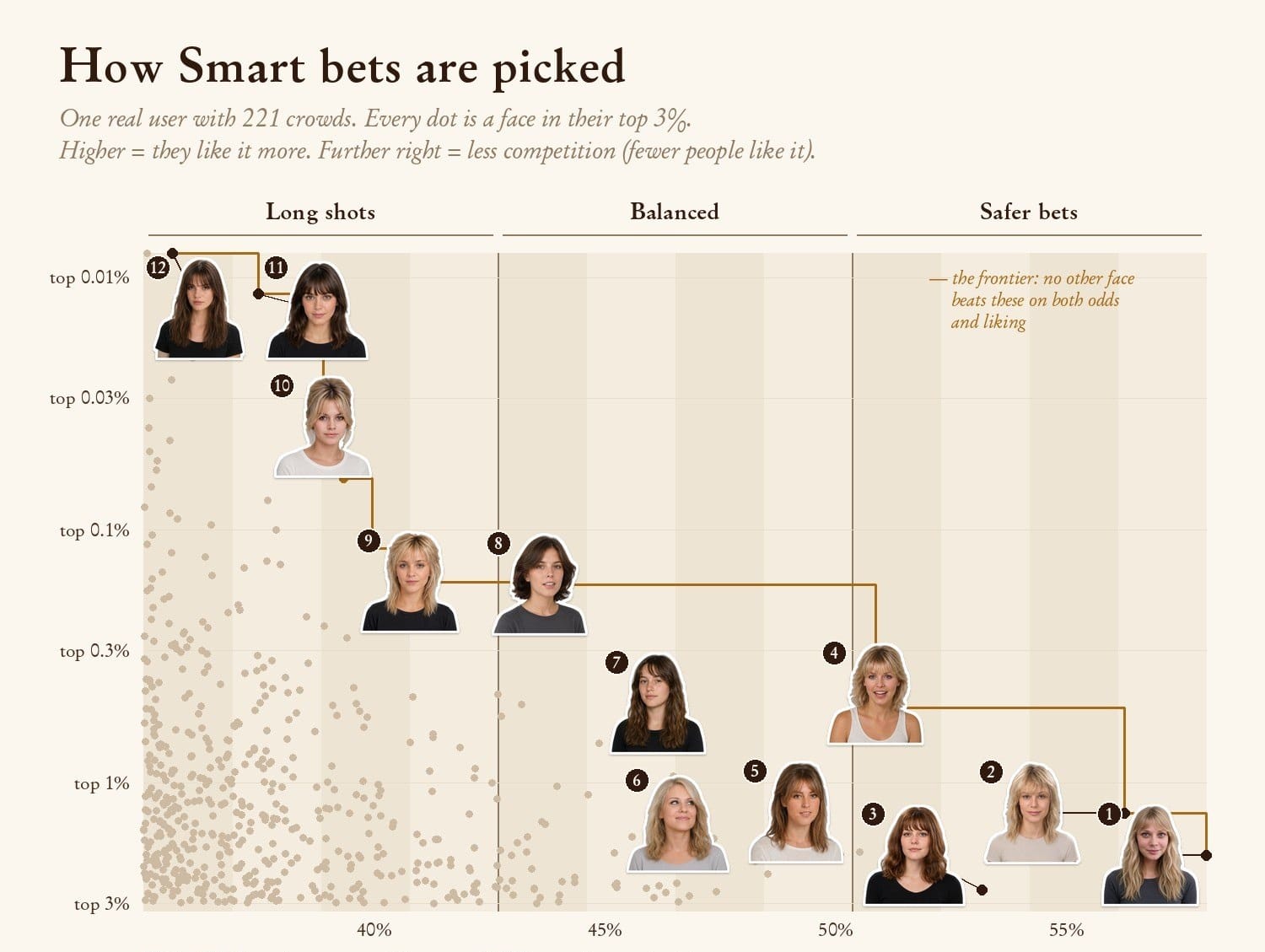
To summarize, MyType’s “Smart Bets” feature combines your winnings with your relationship alpha to concisely identify the set of women you should pursue to optimize your risk-adjusted romance return. (That’s RRR, for short.)
Future Directions
A few caveats before we close. At the time of writing we need to estimate some of the numbers in these calculations using rough rules of thumb. For instance: how much more valuable is a romance in your top 1% than one in your top 2%? What’s the cost of failure? How many faces should be in your portfolio? What’s your own ranking among faces of your own sex? What’s the supply of your face and hers in your local population?
These questions merit further research. In time, MyType will be able to make more and more precise and sophisticated recommendations. Nevertheless, your “Smart Bets” are already useful as they stand. So the real question is: why not give them a try?
Final Notes
One of the central innovations in Dispelling Beauty Lies was applying economic and financial theory to the study of attractiveness. Yet before MyType existed, the resulting conclusions and recommendations were hard to apply in practice. Even today people are uncomfortable when I suggest thinking about romance as if it were an investment.
Well, I can certainly understand the reluctance. We want to feel that romance is sacred and above gambling. But the better we do these calculations, the more romance for everyone. That’s the real goal - and a huge win. Please keep that in mind.
The science of love gambling starts here. I hope this post helped explain why!